
Following Directions Activities for Your Fall Class Party (That Actually Teach Something)
“Draw a ladder leaning against the tree.”
I read the direction aloud and watched twenty-five pencils move. Then I read the next one. Add three pumpkins to the picture.
By the time I reached Draw a scarecrow and a crow, the room was buzzing. When we held the pictures up side by side, nobody’s matched. Ladders on the left. Ladders on the right. Pumpkins in the sky. One scarecrow was wearing the crow as a hat.
The class was laughing so hard I had to wait to ask the question that mattered.
“So whose fault is it? The person following the directions, or the person who wrote them?”
Silence. Then a hand went up. “Kind of… yours?”
Exactly.
Why directions deserve a whole lesson
We ask students to follow directions all day long. We rarely stop and teach what makes a direction good, or what it takes to follow one carefully. Then we’re frustrated when they miss a step.
Clear directions and careful listening aren’t personality traits. They’re skills. And skills can be taught, practiced, and made fun.
There’s a bonus, too. Once students have tried to write directions that someone else can follow perfectly, they understand why you are so specific about procedures. They stop seeing your directions as nagging. They start seeing them as a craft.
Activity 1: The secret pumpkin
This is the one students talk about for days.
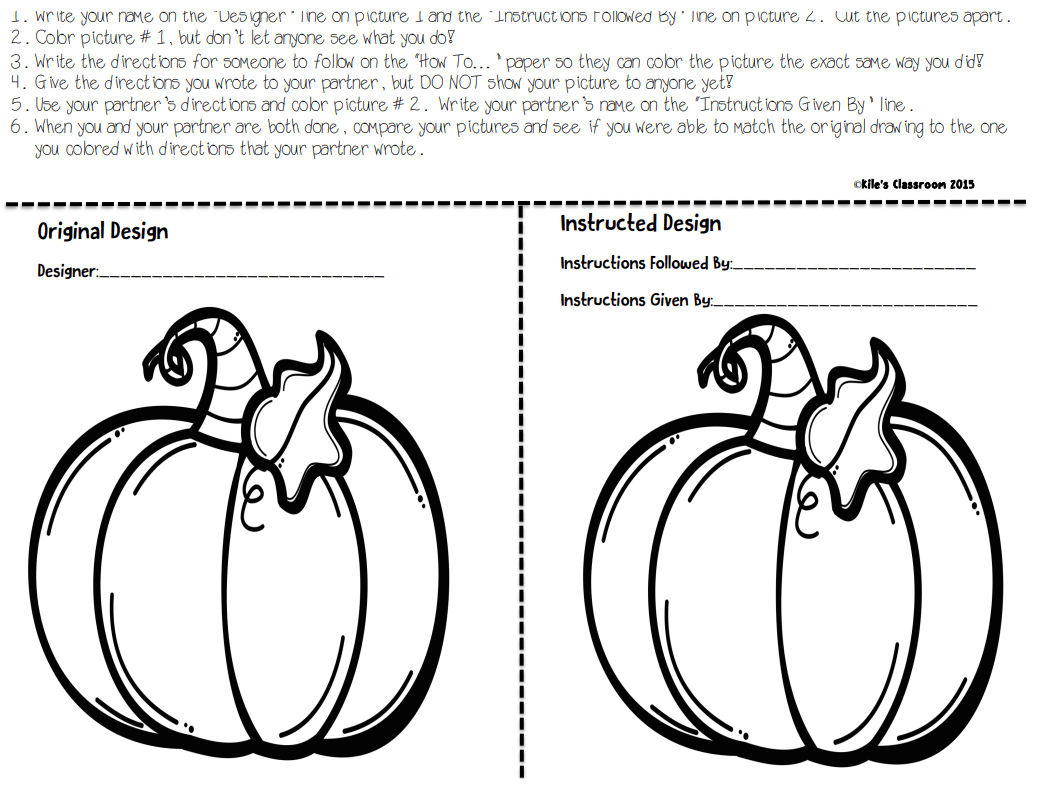
- Each student gets two identical pumpkin pictures and a “How to Color a Pumpkin” writing page.
- Students secretly color the first pumpkin however they like. Stripes, polka dots, a green stem with purple swirls, anything goes. Nobody peeks.
- On the writing page, they write directions so a partner could color the second pumpkin exactly the same way.
- Partners trade directions, but not pictures.
- Each student follows their partner’s directions to color the blank pumpkin.
- The big reveal: partners put the original and the copy side by side.
Then comes the most important part. Partners talk about what matched, what didn’t, and which words caused the mix-up. Color the stripes orange. Which stripes? How many? How thick? Students discover, on their own, that “make it look nice” is not a direction.
Activity 2: The vague directions challenge
This one flips the roles. You read a set of fall directions aloud, intentionally vague, and every student follows along on the same tree picture. Add three pumpkins. Add fall leaves. Draw a wooden fence in the background.
When everyone holds up their pictures, the differences are wild. Then you show the original picture and hand students the written directions. In pairs, they rewrite the directions to be clear enough that every picture would come out the same.
This is revision with a reason. Students aren’t fixing writing because the teacher said so. They’re fixing it because they just saw, with their own eyes, what unclear writing does.
Why it works at a party
A fall party is loud, exciting, and short on structure. These activities give the energy somewhere to go. Each one runs about thirty minutes, works as a station or a whole-class activity, and needs nothing but crayons and copies.
The kids think it’s a game. You know it’s a lesson in procedural writing, precise word choice, and active listening.
Both things can be true. That’s the whole point.
What I use in my classroom
Both activities come from my Following Directions Autumn Holiday Bundle It includes the partner pumpkin activity, the vague directions challenge with an example picture, student revision pages, and a turkey version so you can run it again before Thanksgiving break.
The party is happening either way. You might as well let it teach.
