Teaching the Distributive Property Concretely: The Value Meal Method
I wrote 3(2 + 1) on the board and asked for the answer.
“Seven,” said a student in the front row. Three times two is six, plus one is seven.
Half the class nodded. That’s the moment I erased the board and drew a slice of pizza.
The mistake every math teacher knows
If you have taught the distributive property, you have seen this error. Students multiply the number outside the parentheses by the first term and stop. 3(2 + 1) becomes 6 + 1. 5(x + 4) becomes 5x + 4.
We correct it. We remind them. We write “distribute to EVERYTHING inside!” in big letters on the anchor chart. And the error comes right back on the next quiz.
The problem isn’t that students are careless. The problem is that the symbols don’t mean anything to them yet. They’re following a rule they never understood, so they follow half of it.
Start with lunch
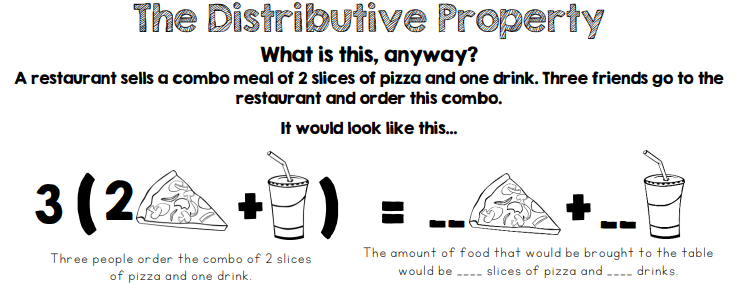
Here’s the scenario I use. A restaurant sells a combo meal: two slices of pizza and one drink. Three friends walk in, and each one orders the combo.
How much food comes to the table?
Every student in the room can answer that. Six slices of pizza. Three drinks. Nobody, not one student, says three friends get six slices and one drink to share. They know that’s ridiculous. Three combos means three of everything in the combo.
Now write it the math way:
3(2 pizza + 1 drink) = 6 pizza + 3 drinks
That’s the distributive property. The number outside the parentheses is the number of people ordering. Everything inside is what comes in the combo. Every person gets every item.
And from that point on, when a student writes 3(2 + 1) = 6 + 1, I don’t say “you forgot to distribute.” I say, “So two of your friends didn’t get a drink?”
They fix it every time.
Move from the meal to the numbers
Once the combo meal makes sense, we strip away the food. 3(2 + 1) = (3 × 2) + (3 × 1) = 6 + 3 = 9.
Then we flip it and use the property as a mental math tool. 4 × 64 is not a fact anyone has memorized. But 64 is just 60 + 4, so:
- Write it in expanded form: 4 × (60 + 4)
- Distribute: (4 × 60) + (4 × 4)
- Multiply: 240 + 16
- Add: 256
The steps never change. That predictability is what makes it teachable.
For practice, students do a card sort. Each problem, like 9 × 53, has four steps scrambled in a pile, and students arrange them in order under the right expression. It’s hands-on, it’s self-checking, and it forces them to see every step instead of skipping straight to the answer.
Then the variables arrive
Here is where the value meal really earns its keep. Breakfast combo: one coffee and three donuts. Four people order it.
4(1 coffee + 3 donuts) = 4 coffees + 12 donuts
Now replace the food with letters. c for coffee, d for donut.
4(c + 3d) = 4c + 12d
Students who were terrified of variables suddenly realize a variable is just a coffee. It’s a label for a thing. They already know how to distribute coffees.
Make it an October problem
This month, swap the restaurant for the class party. Every treat bag gets two lollipops and three pieces of candy corn. There are twenty-four students in the class. How many of each do you need?
24(2L + 3C) = 48L + 72C
Kids will do that problem with more focus than any worksheet you hand them all year.
What I use in my classroom
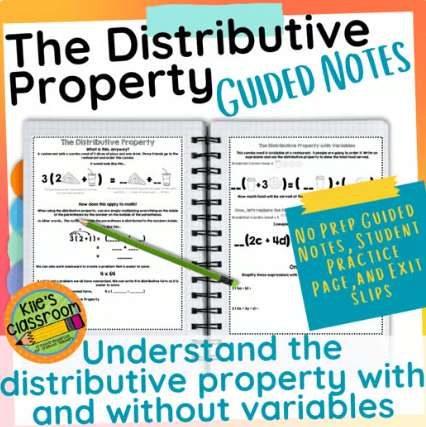
This whole sequence comes from my Distributive Property Interactive Notebook and Practice Activities. It includes the combo meal notebook pages, the card sort, an exit slip for checking understanding, and the variables extension with the breakfast combos, all with teacher answer keys.
Concrete first. Abstract second. The symbols mean something once the pizza does.