I’ll be honest—classroom management was never about keeping kids quiet for me. It was about helping them feel safe, successful, and focused so the learning could stick. I’ve always believed kids do best when they don’t have to guess what’s expected. That’s why I lean on explicit instruction and clear routines every single day.
In my room, the expectations never change:
- Participate
- Share
- Listen
- Respect Others
Whether we’re in the middle of a math lesson or transitioning to get out our notebooks, those four phrases are the anchor. Students know what they mean. They know what they look like. And because of that, we waste less time correcting behavior and gain more time for learning.
How I Teach the Routine
When I use guided notes in my lesson, want to do a whole call review, or give instructions for the next activity, I pair what I say with gestures:
- Simple call and response = Me: “Class, Class.” Them: Yes, Yes” – nothing fancy, cute, or funny. I just want their attention. This is the only one I ever use. They know to look at me and wait after they say “yes, yes.”
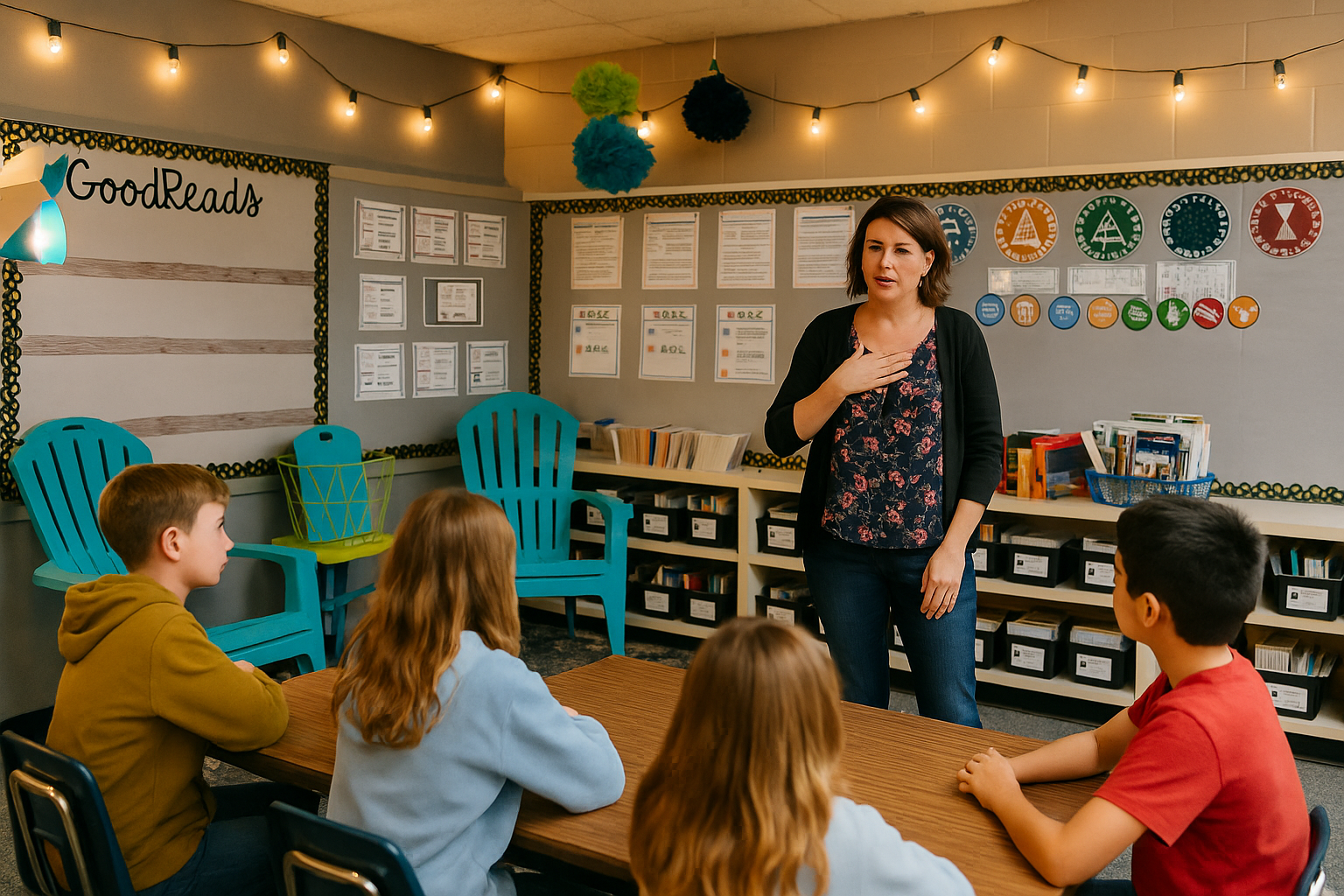
- Hand on my chest = “I’m talking, focus here.”
- Arm extended, palm up = “Your turn to respond.” This can mean a choral response from the entire class, time to raise your hand and be called on, or time to move and transition to the next activity.
The kids know what to do because they know to listen when I am signaling that I am talking. They hear what kind of response I want from them. They wait for the signal to respond.
It’s simple, but it’s powerful. At first, I have to practice this a lot with my students. Every time they miss the mark, I correct it right away. We reset. I hold my hand to my chest, speak again, then signal to them to respond.
But consistency pays off. Soon, my students anticipate my signals. They know what’s coming next, and they respond without me needing to say a word.
The Payoff
I’ve seen what happens when routines are clear:
- Students are calmer because they’re confident in what is next.
- I’m calmer because I don’t have to stop and redirect.
- The flow of the lesson isn’t broken, which means the learning sticks.
And that’s the real win—more teaching time turns into more learning time.
How I Teach Routines with “I Do, We Do, You Do”
I teach routines the same way I teach academics—through the gradual release model: I do, we do, you do.
- I do: I model the routine exactly how I expect it to look and sound. I talk through my thinking out loud—“When I hear the signal, I stop, look at the speaker, and get ready to listen.” Students watch and describe what they notice.
- We do: We practice the routine together. I give cues, use my gestures, and we do it as a group—again and again. This step takes time, patience, and lots of repetition. I correct every missed cue, but with calm consistency.
- You do: When students are ready, they run the routine on their own. I fade my voice and gestures just enough for them to take ownership.
This phase can take days—sometimes a week or more for more complex routines. But every minute spent teaching it upfront saves hours of redirection later. The goal isn’t perfection on day one; it’s mastery through consistency.
What You Can Try Tomorrow
Choose just one routine you want to smooth out. Teach it explicitly with both words and gestures. Model it. Practice it. Correct it. Repeat it.
Step-by-Step Lesson (10–15 minutes)
1) Announce the goal (30 seconds)
- Teacher script: “We’re learning a routine that makes learning smooth. When I do this (hand on chest), you listen. When I do this (arm extended, palm up), you respond by answering or doing the acting I requested. We only move or answer together. ”
2) Define each expectation (1 minute)
- Participate: “Your voice joins when cued; your body shows you’re in.”
- Share: “You answer briefly and clearly on the cue. Calm voices. Clam movements.”
- Listen: “Eyes on the speaker; hands still; voices off.”
3) Model “I Do” (45 seconds)
- Stand where all can see. Hand on chest.
- Script: (use your preestablished attention getter – see above)
- Script: “Watch. When my hand is here, you are listening.”
- Show the wrong way once (looking away, fiddling), then correct:
- Script: “That wasn’t it. Let’s reset. Hand on chest means eyes here, voices off.”
- Script: (use attention getter – put hand on chest) Quietly say- “You are listening and watching me”
- Script: “Arm out and palm up means we respond together. Try this with me. I say two plus two equals”
- Stretch your arm out and palm up. “You say ‘4’”
- Repeat above statement and let them respond.
- Feedback: “We were together. If you spoke early or late, watch my hand and wait for the pause.”
5) Model “You Do” (45 seconds)
- Script: “Let’s do it again. (put your hand on your chest – students look at you) 5 plus 5.” Stretch out your arm. Students will respond “10”.
- Script: Now, let’s try it with a transition. I will give you a set of instructions. You do not move until I stretch out my arm. Let’s try it. (Put your hand on your chest). Go to your desk and get out your math book. (Stretch out our arm and students move. (If students move too early, stop everyone. Reset to the starting position. Restate instructions. Do it again.)
- Repeat this process for several more tasks and responses.
6) Rehearse the full sequence (2–3 minutes)
- Repeat 2–3 fast reps. Keep it brisk.
7) Correct quickly, consistently (ongoing)
- Quiet redirect: “Check your hands; voices off. Try again.”
- Whole-group reset: “We slipped. Back to step one. We can do it.”
8) Name the why (20 seconds)
- Script: “This routine gives us more learning time and fewer interruptions. Smooth = smart.”
9) Try it in real work (3–5 minutes)
- Teach 2–3 minutes of actual content using the cues.
- Keep responses short and snappy. Celebrate a clean run.
10) Close with a micro-reflection (30 seconds)
- Rating: “Show 1–5 with fingers—how well did we follow the routine?”
- One wish: “What’s one thing we’ll do even better next time?”
Practice Plan (first week)
Day 1: Teach the routine (above). 3–5 reps in instruction + 1 rep in a transition.
Day 2–3: Re-teach in 60 seconds; run it in two contexts (mini-lesson + material pass-out).
Day 4–5: Fade voice slightly; rely on gestures first, words second. Eventually, you will only need the gestures after your attention getter. REVIEW the procedure EVERY TIME the class gets sloppy with their responses.
The Teacher’s Role in Making It Work
If there’s one thing I’ve learned, it’s that consistency is everything. Students will follow your lead every single day—so if you expect a routine to stick, you have to model it, reinforce it, and hold the same standard every time. The first few weeks might feel repetitive, but that repetition builds trust. It shows students you mean what you say and that expectations don’t change based on your mood or the time of day. When you are consistent, your students feel secure enough to focus on what truly matters: learning.
This is who I am as a teacher: I believe kids deserve structure that sets them up for success, not punishment that catches them off guard. When routines are clear—and you are consistent—the growth is unstoppable.

 kilesclassroom.com