When we talk about helping our students become strong readers, it’s easy to zero in on phonics and decoding skills. And while these foundational skills are crucial, they’re only half of the story. The other half? Building knowledge. If you’ve been diving into the latest Science of Reading research, you know that students need more than just the ability to sound out words. They need the background knowledge to make sense of what they read.
The Link Between Knowledge and Comprehension

Reading comprehension is more than decoding — it’s about understanding. Think of reading as a puzzle: decoding helps students recognize the pieces, but background knowledge is what helps them see the whole picture. A student can read every word in a text, but if they don’t have enough background knowledge, they’ll struggle to make sense of it.
For example, a student reading about the American Revolution who has never learned about 18th-century history might get stuck on words like “tyrant,” “redcoat,” or “militia.” Even if they can decode these words, they won’t understand the text without the necessary context. But when we spend time building knowledge across content areas, we give students the tools they need to make sense of a wide variety of texts.
Vocabulary: The Building Blocks of Knowledge
A huge part of building knowledge is building vocabulary. Vocabulary is the bridge between decoding and comprehension. Research shows that explicit vocabulary instruction helps students better understand the texts they read and expands their background knowledge for future reading. Here’s why vocabulary building is so effective:
- Vocabulary supports comprehension: Students who understand key vocabulary terms can better grasp the main ideas and details of a text.
- Vocabulary expands knowledge: Teaching new words often introduces new concepts, making it a dual benefit. For instance, when students learn the word “ecosystem,” they also learn about the interconnectedness of living things.
- Vocabulary creates confident readers: When students know the meaning of words in a text, they’re more likely to approach reading with confidence and enthusiasm.
Explicit Instruction: Making It Stick
Explicit instruction plays a critical role in building both knowledge and comprehension. This is especially true in the elementary grades, where students are developing the skills and habits that will shape their reading abilities for life.
In primary grades (K-2): The focus is often on phonics and decoding, but explicit instruction in knowledge building is equally important. This can look like:
- Interactive read-alouds where you pause to explain new words and concepts.
- Thematic units that immerse students in a particular topic (e.g., life cycles, communities, or weather), giving them multiple opportunities to build background knowledge.
- Oral language activities that help students use new vocabulary words in context, deepening their understanding.
In upper elementary grades (3-5): Students are expected to transition from “learning to read” to “reading to learn.” Explicit instruction in comprehension strategies becomes crucial here, as does knowledge building through content-rich lessons.
- Direct instruction in comprehension strategies (like summarizing, questioning, and inferring) helps students make sense of increasingly complex texts.
- Content integration — combining reading with science, social studies, and even math — helps students build the knowledge they need to understand various types of texts.
- Vocabulary lessons that connect to prior knowledge make new words and concepts “stick.” When students encounter new vocabulary words in different contexts, they can deepen their understanding and make meaningful connections.
What Does the Research Say?
The Science of Reading emphasizes that knowledge building is foundational to reading comprehension. According to the Simple View of Reading, comprehension is the product of decoding and language comprehension (knowledge and vocabulary). Recent studies show that explicit vocabulary instruction and knowledge-building activities have a significant impact on reading comprehension, especially for students who come from language-deprived backgrounds.
The Knowledge Gap Theory (Wexler, 2019) highlights how students who lack background knowledge struggle with comprehension despite strong decoding skills. This research suggests that a focus on building content knowledge in the early grades can help close gaps in reading comprehension as students progress through school.
The National Reading Panel (2000) and more recent reviews (e.g., Shanahan, 2020) confirm the importance of explicit vocabulary instruction, noting that students learn best when they are taught vocabulary in context rather than in isolation. When vocabulary lessons are integrated into knowledge-rich units, students retain more information and apply what they’ve learned more effectively.
Practical Tips for Teachers
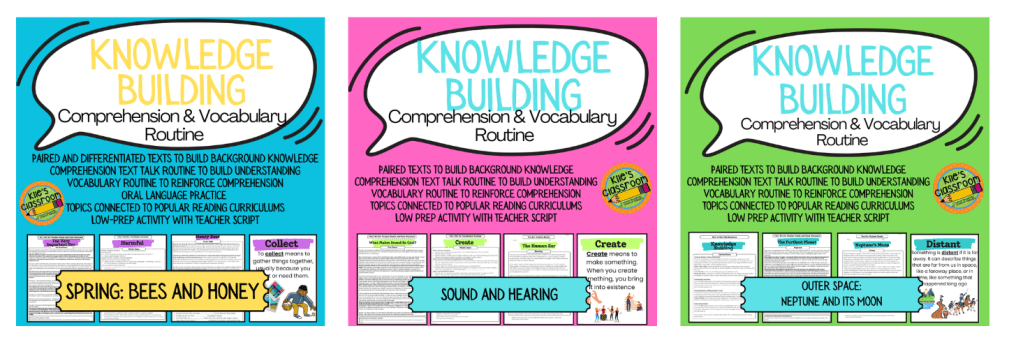
- Plan knowledge-rich units that integrate reading with content areas like science and social studies. For example, a unit on the solar system can include informational texts, vocabulary instruction, and hands-on projects, building a comprehensive understanding of the topic.
- Focus on Tier 2 vocabulary words, which are high-utility words that appear across different texts and subjects. These words (e.g., “analyze,” “observe,” “compare”) are essential for reading comprehension and academic success.
- Use explicit vocabulary instruction techniques, such as:
- Introducing the word in context and explaining its meaning.
- Providing multiple exposures to the word in different texts and activities.
- Encouraging students to use new vocabulary in their speaking and writing.
- Incorporate comprehension strategies into every lesson. Strategies like making predictions, visualizing, and summarizing help students actively engage with the text and process the information they’re reading.
The Bottom Line
If we want our students to become confident, capable readers, we must do more than teach them to decode. We must also help them build a rich foundation of knowledge that makes reading meaningful. By prioritizing vocabulary instruction, integrating content across subjects, and using explicit teaching strategies, we can give our students the tools they need to unlock the power of reading.
The Science of Reading tells us that knowledge is power. Let’s help our students build that power, one vocabulary word and one rich learning experience at a time!
Sources:
- Wexler, N. (2019). The Knowledge Gap: The Hidden Cause of America’s Broken Education System—and How to Fix It.
- Shanahan, T. (2020). The Science of Reading Research and Implications for Practice.
- National Reading Panel (2000). Teaching Children to Read: An Evidence-Based Assessment of the Scientific Research Literature on Reading and Its Implications for Reading Instruction.

 kilesclassroom.com